Algorithm 2&5: Fast query matching
Introduction
Algorithm 5 describes how to map an external query sequence—one not present in the original database—against a pre-built PBWT. While Algorithms 3 and 4 identify internal matches within a dataset, Algorithm 5 provides an efficient way to find maximal matches for new samples by tracking their prefix-sorted position through the database.
Description
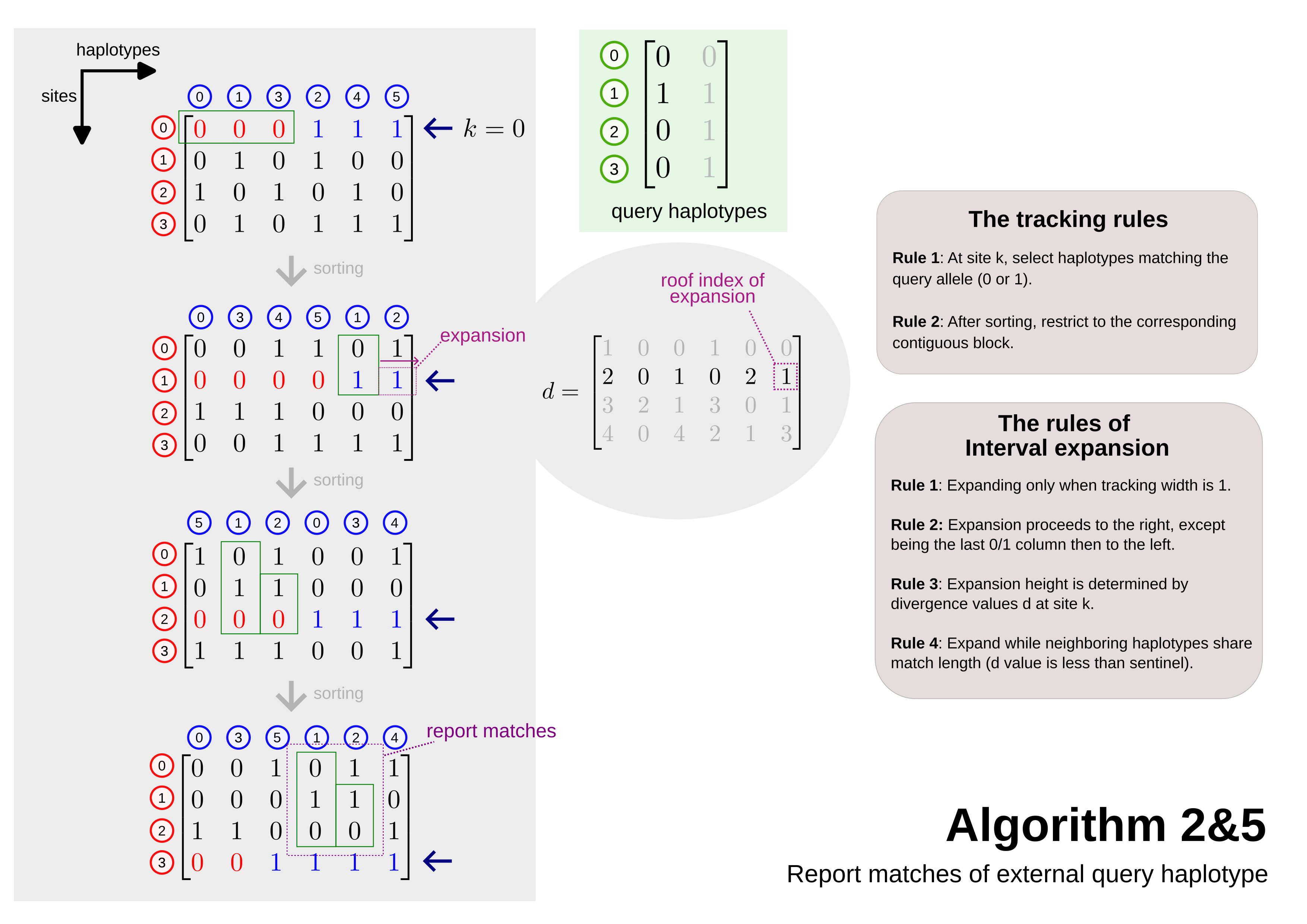
The figure above illustrates the two core phases of Algorithm 5: Tracking and Interval Expansion.
The tracking process
As we process the query sequence site-by-site (\(k\)), we maintain a range (interval) in the prefix array that represents the subset of database haplotypes matching the query. At each site \(k\), the current interval block is identified as the intersection between the previous block (Rule 1) and the match genotype block (0s or 1s, according to the allele of the query haplotype at site \(k\)) (Rule 2).
The rules of interval expansion
When the tracking block converges (e.g., the tracking width narrows to 1), Algorithm 5 performs an expansion to identify all maximal matches.
- Trigger: Expansion is initiated when the tracking width reaches 1.
- Direction: The search proceeds to the right within the prefix array to find neighboring haplotypes. If the search reaches the boundary of an allele block, it expands to the left.
- Height and boundary: The length of these expanded matches is determined by the divergence vector (\(d_k\)). The “roof index of expansion” (highlighted in the divergence matrix) indicates the site where a neighboring haplotype begins matching the query.
- Termination: We continue expanding to neighboring haplotypes as long as they share a match (where the \(d\) value is less than the sentinel at that \(k\), \(\text{sentinel}=k+1\)).
Finally, the algorithm reports these matches (as seen in the “report these” box), identifying which database samples share the longest segments with our external query.
Conclusion
- The query haplotypes must have the same length with PBWT haplotypes.
- Algorithm 5 is highly efficient, allowing a new haplotype of length \(N\) to be mapped against a database of \(M\) samples in \(O(N)\) time. It iterates through sites only once and filters out unrelated haplotypes early.